Not rare. Just missed.
NETs aren't rare. They're dismissed, underdiagnosed and forgotten. This November 10, help Canada take a closer look at neuroendocrine cancer.
Why November 10 matters
World NET Cancer Day was created by the International Neuroendocrine Cancer Alliance (INCA) to raise awareness of neuroendocrine tumours and call for better diagnosis, treatment, information, care and research. Every year on November 10, patient organizations around the world speak with one voice.
Neuroendocrine tumours (NETs) can develop almost anywhere in the body. Their symptoms look like common, everyday conditions, so patients spend years being told it is IBS, rosacea, asthma, menopause or stress. By the time the cancer is found, it has often spread, when treatment is more complex and outcomes are harder.
A cancer that gets missed for years will always look rare on paper. Then "rare" becomes the reason not to fund research, train doctors or raise awareness. This year, CNETS is asking Canadians to change that.
Our 2026 message
Hashtags. Use our campaign tag with the global tags on every post.
#NotRareDismissed #WorldNETCancerDay #LetsTalkAboutNETs #NETCancerDay @netcancerday
CNETS's message sits inside INCA's 2026 global theme, Suspect. Detect. Neuroendocrine cancer., which calls on patients and health-care professionals to recognize NET behind common symptoms and act on it. INCA's materials below carry that theme; ours carries the Canadian story behind it.
Know the signs
- Flushing
- Diarrhea
- Abdominal pain
- Wheezing
- Unexplained weight loss
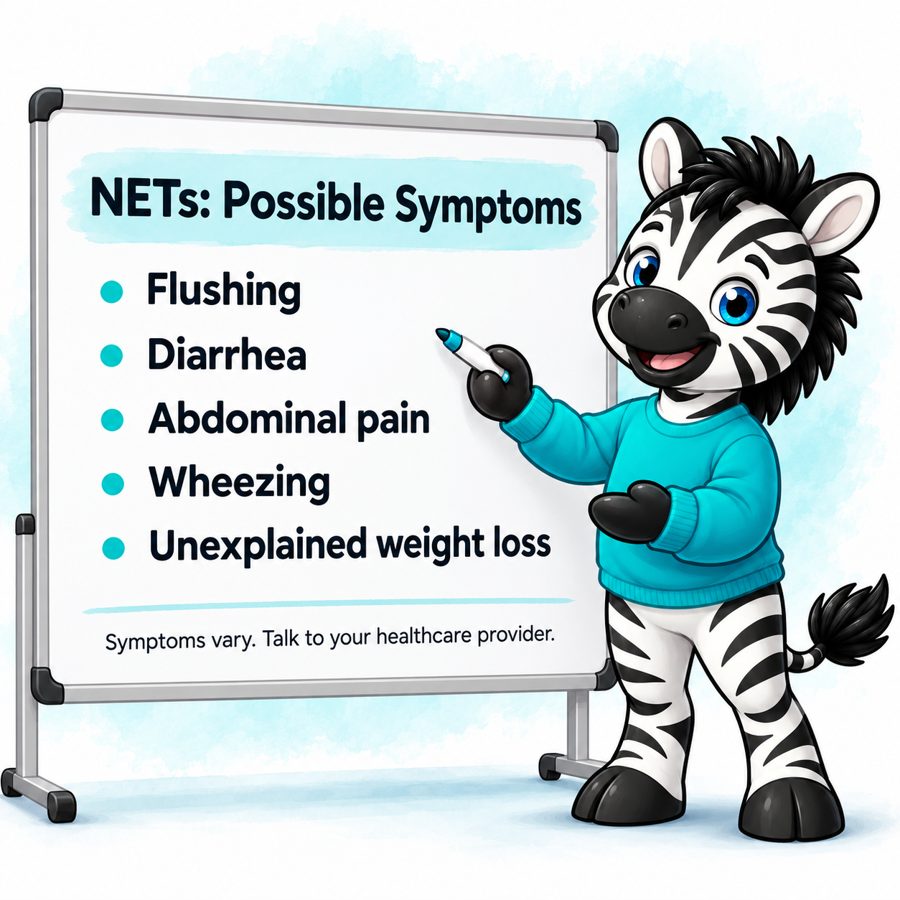
These symptoms are often mistaken for everyday conditions. If your symptoms keep coming back without an answer, keep asking. Ask whether it could be NET. Symptoms vary; talk to your health-care provider.
INCA's global figures: diagnosis takes about five years on average from first symptoms, nearly half of patients are first misdiagnosed, and about a third are diagnosed by chance while being checked for something else. NETs are more common than brain, ovarian or cervical cancer, and incidence is rising.
How to get involved
- Write a letter to your local paper. Your story, in your own words, is the most powerful tool we have. Send it by November 3 so papers can run it before November 10. Letter-writing kit
- Share our posts. Follow CNETS on social media and share our World NET Cancer Day posts with #NotRareDismissed and #WorldNETCancerDay, or post your own using the graphics below.
- Share the signs. Flushing, diarrhea, abdominal pain and wheezing. Send them to someone you love.
- Look up on November 10. Landmarks across Canada will shine teal and white, or zebra black and white, for everyone living with NET. Take a photo and tag us.
- Support the work. Your donation funds research, education and support for Canadians living with NET. Donate
2026 media kit
Everything below is ready to use. Pick the kit for your role, download what you need and keep the message consistent: one line across every channel.
Letter-writing kit
Newspapers choose letters in the days before November 10. You don't need to be a writer. Tell one part of your story: the symptom you were told was something else, how long it took to get answers, or what it has meant for your family. The kit has tips, an example and a template. Send your letter by November 3. If it runs, tell us at info@cnets.ca so we can share it.
Social media graphics
Three Zebby graphics made for this campaign. Right-click an image to save it, then post it with your own words and our hashtags.

INCA 2026 campaign toolkit: Suspect. Detect.
The International Neuroendocrine Cancer Alliance runs the global campaign. Its 2026 theme is early detection. The toolkit has social media graphics, videos, posters and banners for health-care professionals in 11 languages, including English and French. Use them alongside the CNETS materials.
Canada lights up for NET
On November 10, CNETS has asked cities across Canada to light their landmarks teal and white, or zebra black and white, to stand in solidarity with everyone affected by NET cancer. These sites have confirmed so far. More are pending and will be added as they confirm.
British Columbia
- Vancouver City Hall
- Burrard Street Bridge, Vancouver
- BC Place, Vancouver
- Sails of Light, Canada Place, Vancouver
- Vancouver Convention Centre
- Legislative Assembly of British Columbia, Victoria (ceremonial entrance, fountains and Confederation Garden Park, dusk to 1 a.m.)
Alberta
- Calgary Tower (from sunset)
- Lethbridge City Hall (sunset to sunrise)
- St. Albert Place
Saskatchewan
- Regina City Hall
Manitoba
- Esplanade Riel, Winnipeg
Ontario
- CN Tower, Toronto (sunset to midnight; light show at the top and bottom of each hour)
- Hamilton Sign, Hamilton City Hall
- Mississauga Civic Centre Clock Tower
Newfoundland and Labrador
- St. John's City Hall
World NET Cancer Day is also listed on Health Canada's calendar of health promotion days. Requests are in with more cities, including Edmonton, Grande Prairie, Niagara Falls, Montreal, Halifax, Moncton, Charlottetown and Whitehorse. If you see a landmark lit for NET, take a photo and share it with #NotRareDismissed.
Want your city on the list? Most cities take lighting requests from local residents. Write to info@cnets.ca and we'll send you the wording to use.
About CNETS
Founded in 2007, the Canadian Neuroendocrine Tumour Society (CNETS) is a registered Canadian charity dedicated to Canadians affected by neuroendocrine tumours. CNETS raises awareness of NETs among the public and the medical community, and offers support to patients and caregivers through peer-led support groups, phone and email support, and private online communities. The Society provides education through sessions across Canada, the NET Reference Guide and an annual medical and scientific meeting. It advocates for timely diagnosis and access to treatment, and funds Canadian NET research.
Charitable registration number: 85623 3986 RR0001